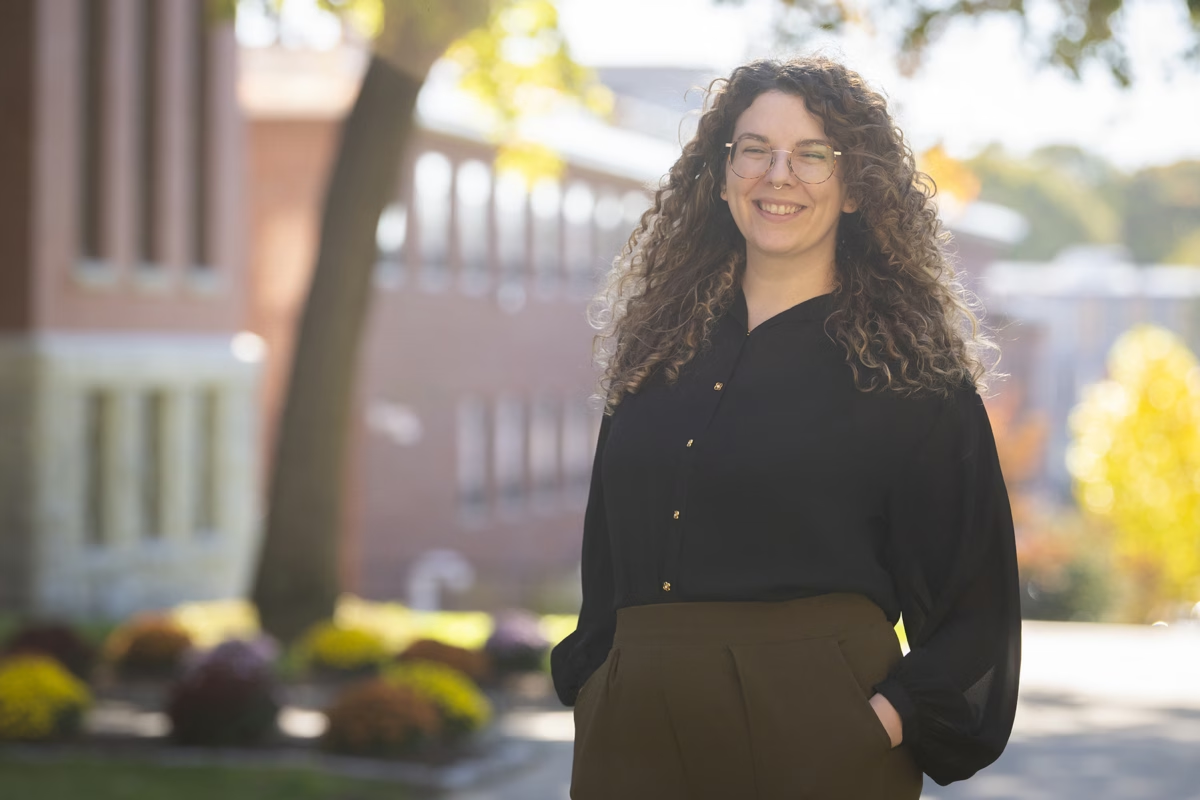
Kortni Wroten, M.S./MBA ’20, returned to Clark on Sept.1 as the University’s director of sustainability, filling a role that had been vacant for five years. During her job interview, she toured campus and was thrilled to see students carrying reusable grab-and-go food containers. She had spent years trying to launch a program like that in her previous job at UMass Chan Medical School — at Clark, it was already running.
Six weeks after becoming a Clark employee, she talked with us about her path back to Clark, her priorities, what really happens to a recycling bin, and why small changes matter.
You earned a dual degree at Clark — an MBA plus a master’s in environmental science and policy. How has that combination helped your career?
A lot of sustainability is about change management, and change can be hard for people. My business courses taught me how to enact long-lasting change in an organization. That’s helped me meet people where they are, build trust, and then work together on sustainability changes, whether at a town, a utility, or a university.
I also learned that sustainability often brings financial benefits. Saving energy is a huge one for many organizations, especially now. Sharing resources and redistributing surplus can be a big win for both sustainability and the budget, and I’ve brought programs like that to every place I’ve worked.
Speaking the language of business has helped in many ways: making the business case for sustainability initiatives, building a budget, and working with procurement offices on policies for buying eco-friendly products. I’m looking forward to bringing that expertise to Clark’s operations and working together to build upon our culture of sustainability.
During my master’s program, I interned with the Town of Concord, Massachusetts, and completed my capstone with the City of Cambridge. I fell in love with how you can work so hard on sustainability and actually see the fruit of your labor. Whether it’s developing guidance, installing charging stations, decarbonizing a building, or moving something off fossil fuels, you can see a project through from concept to completion.
In my capstone, I worked with Cambridge’s Community Development Department on a strategy to reduce emissions through sustainable procurement. That means looking at everything you buy — paper, cleaning products, electronics, even the services you contract for — and using those purchases to support social and environmental sustainability.
I researched how cities and towns across the country build sustainability and social good into their contracts and purchases, whether by buying eco-labeled products or working with social impact suppliers. The project let me use both my business and environmental policy skills, and I got to present it to the city.
Changing procurement can be challenging because there’s a lot of “Well, this is how it’s always been done.” That’s where change-making skills come in.
As I get to know people around campus, all I hear is positivity.
Kortni Wroten
You were at UMass Chan Medical School before Clark. What brought you back?
I was very happy at UMass Chan; it’s a fabulous institution. But when I saw this job listed, I couldn’t say no and had to apply.
I had a wonderful time as a student here, and I felt so supported in both my academics and my job search. Sustainability is my passion, but I also wanted future job security, and my network at Clark was so helpful. Clark also has a great reputation and a long history of environmental education and climate action.
I love being in a role where I can mentor students. Clark has so many sustainability stewards and passionate people. I knew I’d be supported and connected here, and able to help others in their sustainability journeys.
How are you finding Clark’s culture of sustainability?
When I saw the reusable takeaway containers on my interview tour, I was so excited. I wanted to do that in my previous role so badly, but it took a lot of socializing to get there. Seeing it here told me sustainability had kept moving forward even without someone in my role.
As I get to know people around campus, all I hear is positivity. Efforts are already happening, just in a decentralized way. For example, there’s a Microsoft Teams channel for exchanging surplus items, and I’m going to help promote that.
I also learned that students had petitioned for the University to hire a director of sustainability. That’s a wonderful indicator of a strong sustainability culture. It told me I wouldn’t be alone in this role; I’d have the support of the campus. And that’s all I’ve felt so far. People keep saying, “Tell us how we can work with you.”
What’s taking up most of your time right now?
Collecting data for STARS, the Sustainability Tracking, Assessment & Rating System. It’s administered by AASHE, the Association for the Advancement of Sustainability in Higher Education. Almost all the public and private schools I know of report to it, and you get a score that helps you see how well you’re advancing sustainability and where you can improve.
STARS audits everything from academics and research to what we buy and how we dispose of it. It even looks at pay equity, social sustainability, and wellness programs.
Schools are supposed to report every three years, but Clark has never officially reported before. This will be our very first published report. I imagine we’ll have plenty of room to improve our score, and I’d like to submit another report before the three-year deadline to account for the acceleration of sustainability programming my role will bring.
We’ll have a baseline, and through the audit, I’m getting to know people and how things work.
What are your sustainability priorities?
Over the next year, I want to get a sense of where the campus wants to prioritize its climate action. Some campuses really lean into zero waste. Others focus on greenhouse gas reductions or sustainable groundskeeping, which covers both how you physically manage the grounds and the switch to battery-powered equipment.
I attended my first Sustainability and Climate Action Committee meeting last week, and my priorities closely align with what that group is doing, including taking stock of our progress over the years and building an actionable strategy to advance sustainability, climate action, and resilience on campus.
We’re also working on communicating our climate action strategy. There’s still development to do, but we’ve set new greenhouse gas reduction targets. To make progress, I’ve been connecting with our utility partners and power plant leadership to find ways to use energy more efficiently, including lighting updates and other conservation measures. In some residence halls, we’re looking at occupancy sensors so the lights aren’t on in common areas when nobody’s there.
We also just signed a letter of intent to put advance the use of solar energy on campus buildings.
Are there any sustainability efforts on campus that you’re finding people aren’t happy with?
Well, not everyone likes the Tiny Trash Program. The idea is that office occupants get a small trash can attached to their larger recycling bin, and at the end of the day, they’re responsible for emptying it into a centralized trash bin. That means we don’t need plastic liners except in those centralized bins, which saves money and plastic. At UMass Chan, the reduced liners saved more than 1,500 football fields’ worth of plastic in one year. It also saves housekeepers time and makes can make pests easier to control, because trash is collected in one central spot instead of multiple rooms.
One piece of feedback is that new campus staff don’t know what the tiny trash cans are, why we have them, or who’s supposed to empty them. Our communications could use some bolstering. I’d like to see Tiny Trash and other sustainability information included in new staff onboarding.
I get it — it’s inconvenient. But it’s good for long-term sustainability.
And I know some people wonder how we handle recycling. I can assure everyone that whatever is put in a recycling bin gets recycled.
It sounds like communication is a huge part of your role.
Absolutely. It’s about communicating what we already do well, what we need to do better, and what people can do to help. I want to highlight the work people have been doing and bring attention to the impact of their projects.
For example, there’s a pollinator garden in the strip outside the Kneller Athletic Center, in front of the windows where you see the Bickman Fitness Center. Under the guidance of biology professor Beth Bone, students designed it through a course called Ecological Restoration. I thought that was so cool — but nothing tells you what that space is for. Native plants can look stick-like or dry during certain times of year. A sign that says, “This looks this way intentionally, because it’s supporting nesting and resting pollinators,” becomes a learning opportunity. We’re working to create more of those spaces on campus, and a little signage goes a long way.
What other projects are in the works?
I’m working with the Division of Student Success on a map of our water bottle filling stations. Dr. Bone and I are creating a sustainability map, and I’m hoping we can incorporate some of those features into admissions tours. Prospective students want sustainability.
I’m also building a sustainability website and will eventually launch social media to highlight small efforts. And I’m hoping to get a student worker next year to help brainstorm and implement ideas.
We have a living laboratory here in the Clark campus. We can try things out and learn from the results. Not everything works, especially not the first time. But it’s always a learning experience. It gives you another avenue to try and another obstacle to overcome. And truthfully, sometimes I like a challenge.
Sustainability takes a lot of people doing a little, rather than a few doing a ton. It can be so much more impactful when people make little changes every day. I want to highlight that and help people see the importance of small changes. It’s so much more than recycling.