Clark University Academics & Faculty
950 Main Street • Worcester, MA 01610
Tel: 508-793-7711 • academicaffairs@clarku.edu

Environmental Science and Policy
The Environmental Science and Policy (E.S.&P.) program offers a major and an accelerated B.A./M.A. fifth-year free option for qualified Clark undergraduates. It is part of the International Development, Community and Environment Department (IDCE), which also offers an M.A. in Environmental Science and Policy.


Accelerated B.A./Master’s Degree Program in Environmental Science and Policy

Overview

The environmental field in the 21st century is evolving fast to respond to complex interdependencies between the natural environment and human development.

The mission of the Environmental Science and Policy (ES&P) graduate program is to educate students to become leaders of, and contributors to, the rapidly evolving field of environmental science and policy; and to prepare students for careers at the intersection of environment, technology, society, and development. The ES&P graduate program both contributes to and draws from the interdisciplinary culture of the Department of International Development, Community and Environment (IDCE) at Clark University.

ES&P teaches students to synthesize knowledge and methods from the natural and social sciences, including how to apply appropriate quantitative and qualitative analytical tools like GIS, air, water and soil quality sampling, computer modeling, surveys and focus groups. ES&P also equips its graduates with the ability to work with a wide array of stakeholders – communities, industries, governmental agencies, NGOs, researchers and donors – in ways that are sensitive to cultural, institutional, socio-political, and economic contexts.

Our graduates are able to recognize, frame, characterize and address problems creatively at the intersection of environment, technology, society, and development. We believe that respect for a variety of opinions, cultures and types of knowledge underpins the success of our work, and that ideological, rigid, and overly narrow approaches represent barriers to solving environmental problems in a sustainable way. We are known for raising and addressing the hard questions – not blindly accepting “conventional wisdom” without proof and validation.

The field of environmental science and policy is evolving rapidly. In the early 1970s, Clark University started one of the first environmental programs in the country to explore the relationship between science, technology and society. Today, the ES&P program continues that tradition of innovation at the interfaces between environment, technology, society, and development.

Learn about the ES&P Program.

Visit the IDCE website to learn more details about the ES&P graduate program.

Eligibility Requirements

The accelerated B.A./Master’s program provides intensive graduate study of ES&P in combination with a liberal arts B.A. degree. Students in any undergraduate field are accepted for the M.A. degree, though undergraduate Environmental Science majors do have a significant advantage in preparation. A cumulative average of 3.25 or better must be maintained throughout the senior year. A request for admission to the combined accelerated B.A./Master’s program is made to the ES&P program advisor during the junior year and will be granted in the senior year on presentation of an acceptable program of undergraduate study.

The accelerated B.A./Master’s student enters the fifth year with two graduate course credits that transfer from the undergraduate degree into the MA program. So students in the accelerated B.A./Masters program should take two graduate level ES&P courses in their senior year.

Both acceptance into the graduate program and the granting of full tuition remission for the fifth year are subject to the approval of the ES&P Graduate Admissions Committee and the Dean of Graduate Studies. In the accelerated B.A./Master’s program, while the fifth year is tuition-free, students can extend their MA studies into subsequent semesters at their own cost.

Master’s Degree Requirements

Completing the ES&P Master’s degree requires completing 12 course units and a final project. The 12 course units include five required core courses, two skills courses, and then five elective courses to provide breadth and depth. The five elective courses typically focus on topics reflecting the student’s particular environmental interest and can also include directed study and guided internships. We encourage students to take advantage of the diversity of courses offered throughout Clark University, and consider enrolling in courses offered in the other programs in the Department of International Development, Community, and Environment, and in other departments (particularly geography, economics and biology) as approved by the student’s faculty advisor.

ES&P Required Courses (4 plus final project)

The ES&P core courses provide ES&P graduate students with a common academic foundation. Each of the four core ES&P faculty members teach a core course that all ES&P graduate students must take. In addition to these 4 core required courses, all students are required to register for a course (either a directed study, internship, or research course) that is designed to facilitate completion of their Final Project.

1. IDCE 363 Decision Methods for Environmental Management and Policy
2. IDCE 382 Management of Environmental Pollutants
3. IDCE 30205 Climate Change, Energy and Development
4. IDCE 30287 Fundamentals of Environmental Science
5. ES&P Final Project

ES&P Skills Courses (2 skills courses are required)

A sampling of skills courses include but are not limited to:

• Sustainable Development Assessment & Planning
• Principles of Negotiation and Mediation
• Environmental Research Design and Development
• Raster Geographic Information Systems (GIS)
• Vector Geographic Information Systems (GIS)
• Advanced Topics in Spatial Analysis
• Quantitative Modeling
• Advanced Remote Sensing
• Digital Image Processing
• Decision Making and Negotiation in Community
  Development

ES&P Elective Courses (5)

Elective courses provide students the flexibility of designing much of their coursework to suit their own needs and to provide depth in a chosen area of focus. Students may take courses offered by the other three graduate programs in IDCE or in other departments, as approved by their ES&P faculty advisor.

A sampling of elective courses include but are not limited to:

• Sustainable Production and Consumption
• Environmental Toxicology
• Corporate Environmental Management
• Environmental Law
• Environment, Poverty and Health (half course)
• Environmental Chemistry
• Economics of Natural Resources
• Technology and Sustainability: Perspectives from
  the Global South
• Gender, Environment and Development
• Urban Ecology
• Development and Community Planning Theory
• Social Movements, Globalization and the State
• Applied Ecology

Directed Study and Guided Internships: Students can take up to a total of two units of directed study or guided internships with a specific faculty member who agrees to guide the independent work (students may petition to take more than two units). So, in addition to the Final Project course requirement, students may opt to have an additional course of directed study or internship as an elective. To provide structure for working on the final project, students completing a professional project typically take one directed study or guided internship course, while students choosing the thesis option typically take two directed study courses.

Coursework Timetable

The ES&P Master's degree requires 12 course credits. The accelerated B.A./Master’s student enters the fifth year with two graduate course credits that transfer from the undergraduate degree into the M.A. program. The remaining 10 courses are comprised of: four credits of required core courses, two skills courses, and four electives, which often includes one or two internship credits.
Up to two course credits may be earned for guided internships (post-B.A.). These two course credits may be taken in two ways:

EITHER

1) One internship taken in the summer before the M.A. program, and one in the summer after the Spring semester of the fifth year;

OR

2) A year-long academic internship after the senior year can be undertaken and counted as two course credits toward the accelerated B.A./Master’s if that internship is part of a funded academic fellowship through Clark, such as year-long Fulbright, a Compton Mentor, or a Boren Fellowship. This year-long internship must have prior approval from the University's Graduate School for the returning student to remain eligible for an accelerated B.A./Master’s with the fifth year free.

Contact

For information on specific course requirements and the ES&P Accelerated B.A./Master’s Degree Program, contact the Coordinator of the ES&P Accelerated Program: Professor Sam Ratick in the Environmental Science & Policy Program.

ES&P Student Notes

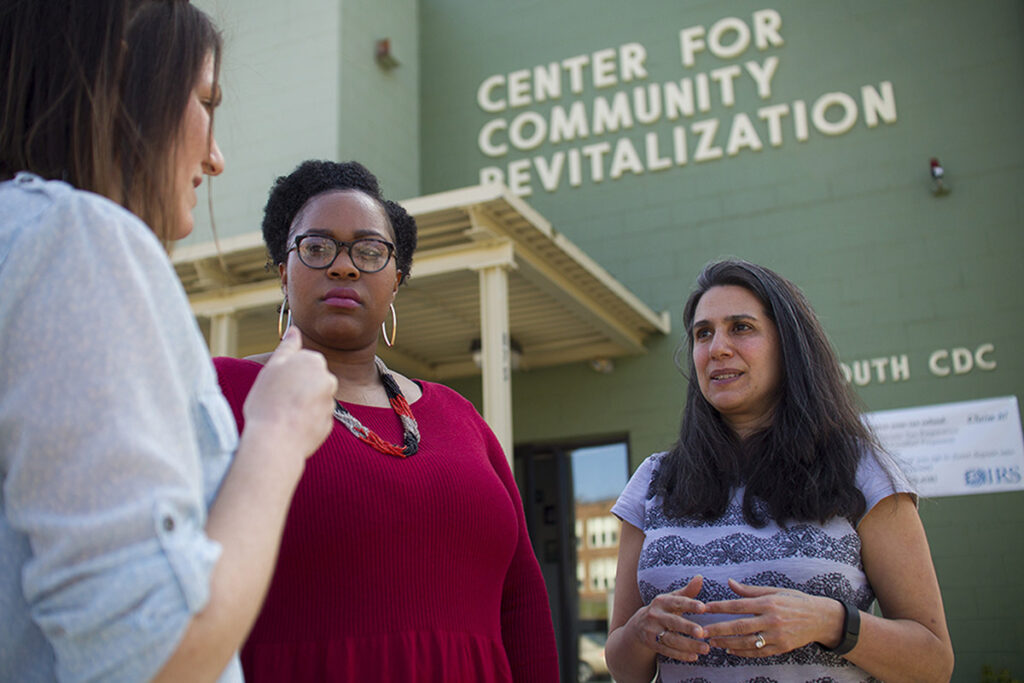
Suela John (ES&P/BA ‘10) is working as a research assistant on the Environmental Justice grant project. The internship is focused on indoor environmental sampling, using indoor environmental testing to learn more about the communities at risk in the Main South and Piedmont neighborhoods.

Stephanie L. Oleksyk (ES&P/BA/MA ‘08) is currently an intern at Corporate Environmental Advisors of West Boylston, writing a release abatement measure plan (RAM) for a former liquid waste dump in Leicester, Mass. This paper will be submitted to the Mass. Dept. of Environmental Protection before a voluntary clean-up of the site.

Laura Merner (ES&P/BA ‘08) received a Research Experience for Undergraduates Fellowship from the National Science Foundation to work on integrated watershed sciences at the University of Texas, Austin. This opportunity allowed her to travel to Mexico and conduct in-situ water quality analysis. She plans return to Austin to intern at the Center for Environmental Research to conduct an independent study involving riparian zone ecology and water quality and quantity. She will also assist a youth river watch program to raise awareness about the environment and promote environmental studies.

Michael Miller (ES&P/BA/MA ’02) is a corporate environmental health and safety engineer at Textron, Inc., where he is involved with environmental metrics development, systems work for data, policy compliance, and remediation management.

Danel (Francoeur) Eitel (ES&P/BA ‘99/MA ’00) is currently an environmental earth science teacher at South Windsor High School in South Windsor, Connecticut.


Contact Information Search

Academic Catalog & Requirements
Program & Courses
Major Requirements
Honors Program

Additional Resources
Programs Home
History of ES&P at Clark
Meet ES&P Undergraduates
Meet ES&P Interns
Student/Faculty Research Collaboration
ES&P Graduates
Environmental Science
Careers in ES&P (PDF) Internships in ES&P (PDF)

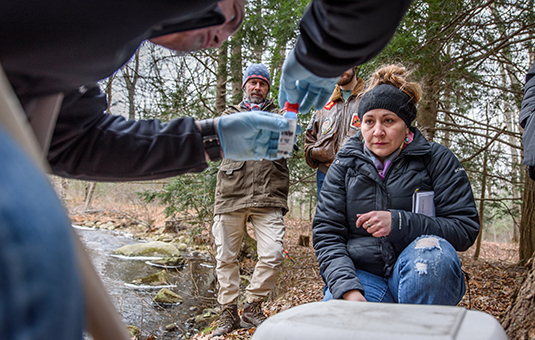
Sampling water quality

You may also be interested in:
Biology
Geography
Global Environmental Studies
HERO Program

© 2008 Clark University·